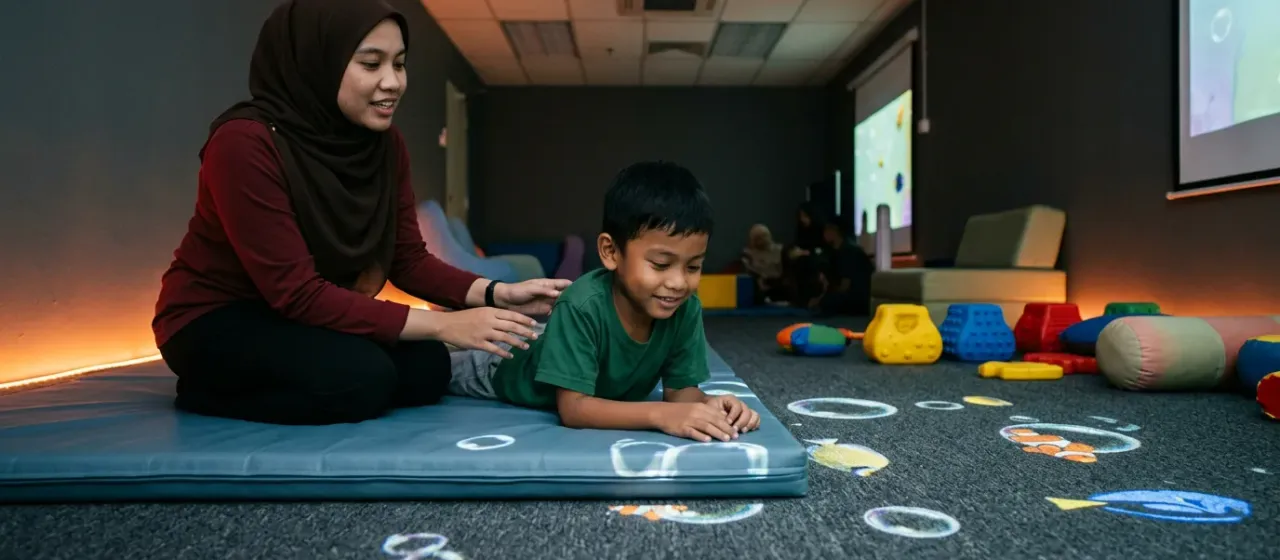
How does the Sensory Projection Training Games work?
- Mount the projector above the floor area.
- Place a sensor to read movement.
- Start a gentle scene from the host computer.
- The child moves a hand or foot over the floor.
- Bubbles and fish drift or scatter in response.
What comes with the Sensory Projection Training Games?
- Floor projector
- Motion sensor
- Host computer with sensory games
What space and power does the Sensory Projection Training Games need?
| Play area | A clear, padded floor area with space for a therapist to kneel |
|---|---|
| Mounting height | A standard room ceiling is enough; projector mounting confirmed on site |
| Power | A standard power point |
| Network | Not needed for play |
Sensory Projection Training Games specifications
| Lighting conditions | Moderate or less |
|---|
Where is the Sensory Projection Training Games used?
Shipping and installation
We ship worldwide from Malaysia. Warranty terms and installation support are confirmed in your quote.
Sensory Projection Training Games: questions buyers ask
Is the sensory projection too stimulating?
The Sensory Projection Training Games use slow, gentle scenes, but every child reacts differently. A therapist stays with the child and can stop the projection or switch to a calmer scene at any time.
Does the child need to stand?
No. In the Sensory Projection Training Games a child can lie, sit or crawl on the mat. The sensor reads movement over the floor, not only steps.
How dim does the room need to be?
Moderate light or less suits the Sensory Projection Training Games. A dimmed room keeps the projected bubbles and fish clear. Daylight through large windows can wash out the floor picture, so curtains or blinds are worth planning.
Can the therapist change the scenes?
Yes. The therapist changes scenes on the host computer in the Sensory Projection Training Games. Ask us which scenes suit your children before ordering, and we describe what is available for your age group.